Indian businesses are expanding globally faster than ever. Digital services, SaaS products, physical goods, and consulting now routinely cross borders. Having global customers is a genuine growth opportunity, but accepting international payments is rarely as seamless as it sounds. Conversion rates, settlement delays, compliance obligations, and the operational overhead of managing multiple payment systems can turn what should be straightforward revenue into a fragmented, time-consuming process.
Pay10 is built to resolve exactly this. As an RBI-authorized PA-CB (Export & Import) and Online Payment Aggregator, it gives Indian merchants a single, compliant cross-border payment infrastructure that handles both domestic and international collections, with the compliance documentation, settlement reporting, and currency conversion built in from the start.
For merchants who have been stitching together bank wires and regional gateways, Pay10 is what a properly integrated international payment setup actually looks like.
Most Indian merchants arrive at a dedicated cross-border payment platform after hitting the limits of one of two default paths and discovering that neither scales cleanly as international revenue grows.
Traditional bank wire transfers
Reliable in the sense that money eventually arrives, but slow, often taking several business days to settle, with limited visibility into where a payment is in the process. SWIFT fees, correspondent bank deductions of $10–25 per intermediary, and FX markups of 1–4% embedded invisibly in the conversion rate are all standard costs of the wire transfer route.
Compliance documentation, FIRA, and purpose code tagging require a separate manual request to the bank after each payment, rather than being generated as part of the settlement flow.
Multiple regional gateways stitched together
A domestic gateway for INR orders plus a separate international processor for foreign cards means two dashboards, two reconciliation processes, two support lines to chase when something goes wrong, and two separate compliance trails to maintain for FEMA and GST purposes. As the merchant adds new markets or currencies, this fragmentation compounds.
Pay10 replaces both patterns with a single, RBI-authorized system, one integration, one dashboard, and one compliance trail, covering domestic INR payments and international cross-border collections simultaneously.
Power everyday transactions with secure digital payment infrastructure built to support scale, speed, and convenience.
International payments in India are governed by RBI's PA-CB (Payment Aggregator – Cross Border) framework, introduced in October 2023. Every non-bank entity aggregating cross-border payments for Indian merchants must hold a valid PA-CB authorization. Operating through a non-PA-CB-licensed gateway creates a compliance gap in the settlement trail, one that surfaces at tax time, during a GST audit, or when FEMA documentation is requested.
Pay10 holds RBI authorization as a PA-CB (export & import), one of the few fintech platforms in India with this license for both inward collections and outward payments. What this means practically for a merchant: every international payment processed through Pay10 flows through AD Category-I bank routing that meets FEMA's requirements, with correct RBI purpose code tagging built into the transaction workflow, FIRA generated automatically for every eligible inward remittance, and merchant onboarding aligned to the CKYCR-based KYC requirements that took effect from January 2026.
The compliance infrastructure runs in the background. Merchants do not need to build an in-house compliance function or manage purpose codes and FIRA requests manually; Pay10's PA-CB-authorized platform handles it as part of the standard settlement flow.
A common operational challenge for Indian merchants scaling internationally is the fragmentation between domestic and international payment systems. Indian customers paying in INR via UPI, cards, or net banking go through one gateway. International customers paying in USD, EUR, GBP, AED, or SGD go through another. Settlement reports, reconciliation, and compliance documentation need to be pulled from two separate places and matched manually.
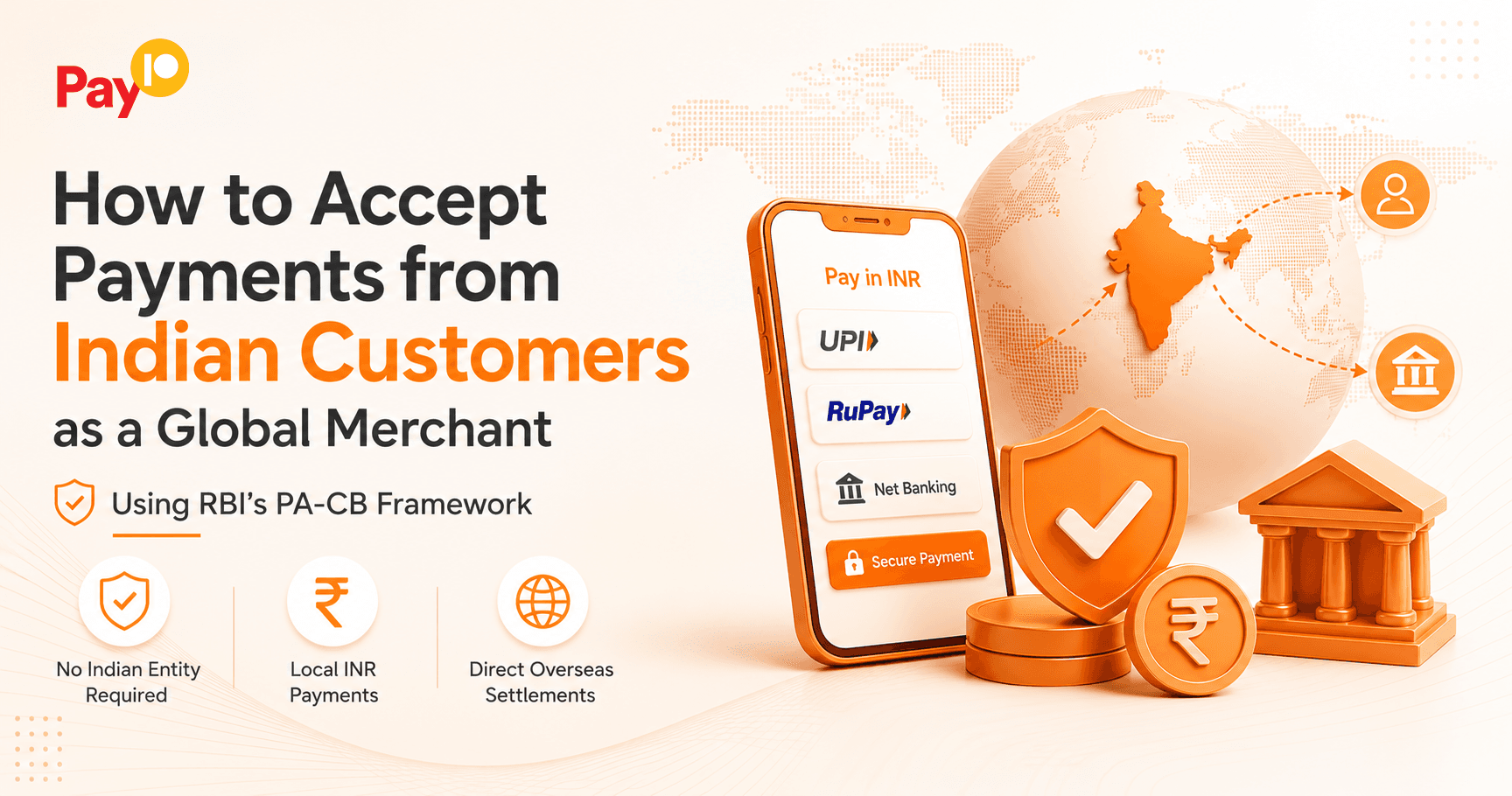
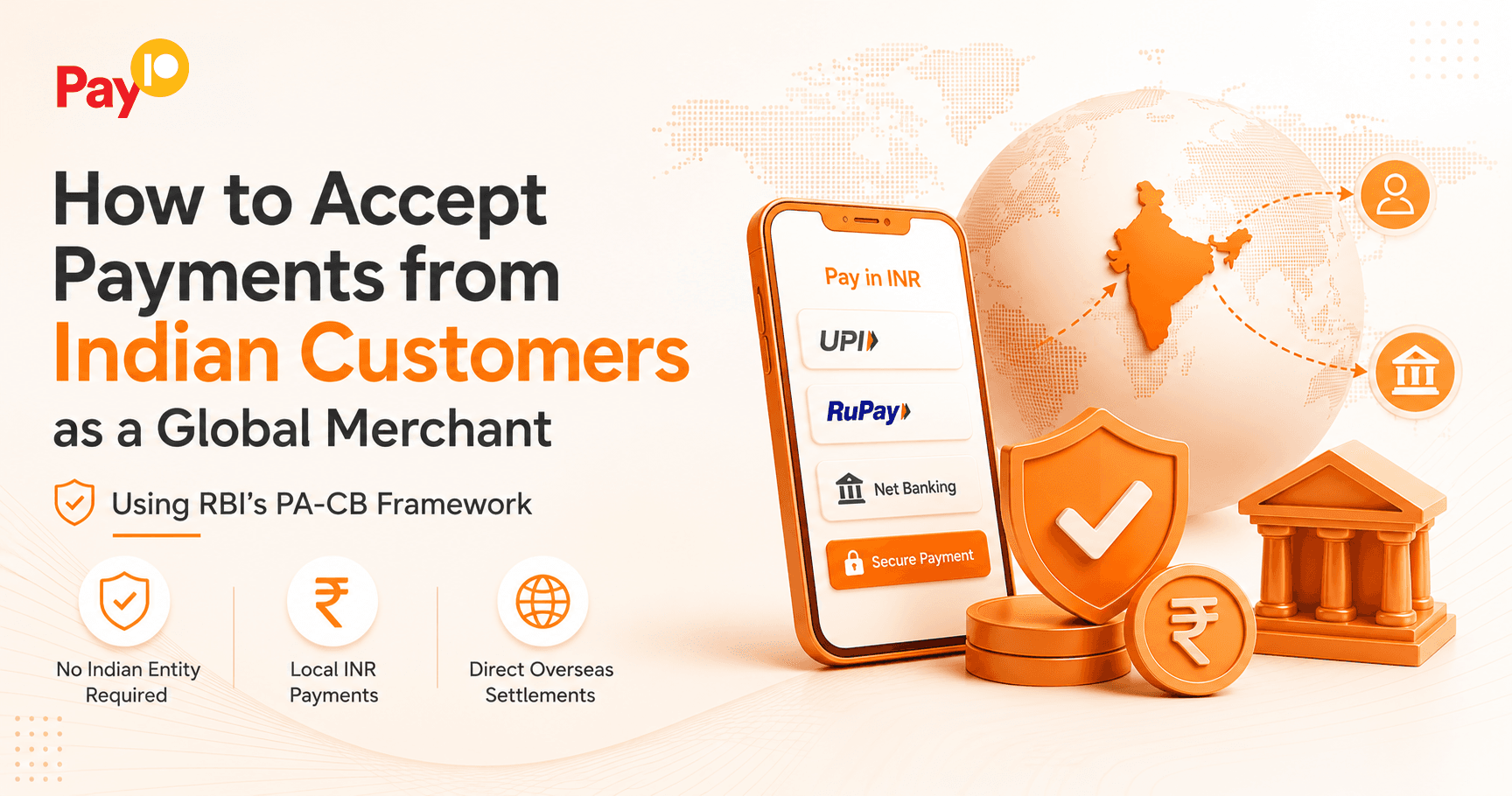
The Pay10 payment gateway covers UPI, RuPay, domestic cards, net banking, and digital wallets for Indian customers. Pay10 World covers cross-border collections in 100+ currencies for international customers. Both sit within the same merchant dashboard: one place to check settlement status, one reconciliation process, and one compliance trail.
For a D2C brand managing orders from India, the US, UAE, and UK simultaneously, this consolidation directly reduces the finance team's operational overhead. Every transaction, domestic or international, is visible in one place, settled on a predictable schedule, and documented with FIRA and purpose code records already attached.
Pay10 is built to work across different business models and technical setups; merchants are not forced into a single integration approach that may not suit how they actually sell. Three integration options are available, covering everything from a no-code setup to a fully embedded custom checkout.
Hosted payment pages give merchants a ready-made, Pay10-hosted checkout without engineering effort. Customers are redirected to a secure payment page, complete the payment, and are returned to the merchant's site. Suited to merchants who want to go live fast without building a custom integration.
Shareable payment links are ideal for invoicing international clients, social commerce, WhatsApp-based selling, or one-off custom orders. The merchant generates a payment link from the Pay10 dashboard and shares it via any channel: email, WhatsApp, Instagram, or SMS. The customer clicks, pays in their preferred currency, and the merchant receives settlement in INR with FIRA already generated.
API and SDK integrations allow merchants to embed the full payment flow directly into their own website, mobile app, or SaaS billing system. This is the right approach for merchants who want the payment experience entirely within their own product, no redirects, fully branded, with Pay10's compliance and settlement infrastructure running in the background.
Explore Pay10's integration methods to see which approach fits your setup.
Settlement predictability and documentation quality are the two things Indian merchants most commonly cite frustrations with their existing international payment setup. Delayed settlements affect working capital. Missing FIRA documentation creates problems at tax time and during FEMA audits. Both are avoidable with the right payment infrastructure.
Pay10's international payment gateway settles inward remittances to the merchant's verified Indian bank account within T+2/T+3 business days, on a predictable schedule, not subject to the open-ended waiting periods that come with SWIFT wire transfers. Real-time currency conversion happens through AD bank partnerships at transparent rates, with no hidden FX markup applied on top. The rate the merchant sees is the rate they receive.
FIRA is generated automatically for every eligible inward remittance and is accessible directly from the Pay10 merchant dashboard. There is no need to submit a separate bank request after each payment, no waiting 7–15 days for the document, and no manual matching of remittance advice to invoices. For Indian exporters, FIRA is the prerequisite document the AD bank needs to generate an eBRC; having it auto-generated for every transaction directly accelerates GST refund and DGFT incentive claim workflows.
The unified merchant dashboard provides full visibility across authorizations, settlements, outstanding collections, refunds, disputes, and reconciliation for both domestic and international transactions in one view.
Built for the future of payments, Pay10 enables businesses to offer fast, secure, and scalable digital payment experiences.
Pay10's payment infrastructure is certified to PCI-DSS Level 1 - the highest tier of PCI compliance, required for platforms processing large volumes of card transactions, and to ISO 27001:2022, the international standard for information security management. Both certifications apply across the Pay10 platform, covering domestic and international payment flows.
Advanced fraud prevention and risk monitoring are built into every transaction. Tokenization, 3DS authentication for card transactions, encryption in transit and at rest, and real-time transaction monitoring are all part of the standard infrastructure, not optional add-ons. For merchants handling international card payments where cross-border fraud risk is higher, this risk infrastructure directly supports higher transaction approval rates and lower chargeback exposure.
As a merchant's international volume grows, with more currencies, more markets, and more transactions, Pay10's infrastructure scales without forcing a platform migration or a new integration. The same setup that handles a D2C brand's first international orders handles the same brand's cross-border payment flows at 10x that volume, with the same settlement predictability and the same compliance documentation quality.
Consider a D2C skincare brand based in Delhi that starts receiving orders from the US, UK, UAE, Singapore, and Australia through its own website and social commerce channels. Without a unified setup, this brand needs a domestic gateway for Indian INR orders, a separate cross-border processor for foreign cards, manual tracking across five different settlement currencies, and its own process for generating FIRA documentation for each country's payments, all reconciled manually by a finance team that was not built to handle five simultaneous currency corridors.
With Pay10, the same brand uses one integration to accept all five currencies - USD, GBP, AED, SGD, and AUD - through hosted payment pages, payment links, or API checkout. Every domestic INR order from Indian customers goes through the same dashboard. International settlements reach the brand's Indian bank account in T+2/T+3 business days per currency, with FIRA auto-generated and purpose codes correctly tagged for every inward remittance. The finance team reconciles one dashboard, not five. The compliance documentation trail is already built; no manual reconstruction required at GST time.
This is the operational difference Pay10 makes for a growing international merchant: not just accepting more currencies but removing the compounding operational overhead that comes with each new market added to the mix.
International payments do not have to mean slow bank wires, scattered gateways, or a manual compliance process rebuilt from scratch with every new market.
Pay10 integrates PA-CB-compliant cross-border collections, multi-currency support across 100+ currencies, flexible payment acceptance methods, automatic FIRA generation, transparent FX conversion, and clear settlement reporting into a single, RBI-authorized platform so Indian merchants can focus on serving global customers while the payment infrastructure handles the rest.
For merchants ready to replace fragmented international payment setups with a single, properly built solution, Pay10 is designed to be exactly that. Explore Pay10's international payment gateway, learn about Pay10 World, explore UPI for Global Merchants, or get in touch with our team to get started.
Why Businesses Trust Pay10 | RBI Authorized Payment Aggregator | PCI-DSS Compliant | ISO 27001 Certified | 100+ Payment Options | Advanced Fraud Prevention & Risk Monitoring | Trusted by Enterprises & Growing Businesses | Scalable Infrastructure for India & Cross-border | Enterprise-grade Payment Technology | Secure UPI & Digital Payment Solutions