
Pay10 is an RBI-authorized payment aggregator and fintech platform helping businesses across India simplify digital payments with secure, scalable, and enterprise-grade payment solutions. Trusted by startups, SMEs, enterprises, D2C brands, and growing businesses, Pay10 supports UPI, cards, net banking, wallets, payment links, international payments, and advanced merchant solutions designed for modern digital commerce.
If you sell on Amazon Global Selling, run an Etsy shop, or ship internationally from a Shopify store, you have already been through some version of KYC, whether it felt like it or not. Every marketplace and every payment processor sitting behind it is required to verify who you are and where your money is going before allowing a single international payment through. This is not new. What has changed is how consistently these checks are enforced, how much documentation is expected upfront rather than requested mid-payout, and how tightly the payment infrastructure behind these marketplaces is now regulated.
The RBI's PA-CB (Payment Aggregator - Cross Border) framework, introduced in October 2023, is the most significant structural change affecting cross-border seller compliance in India. It requires all non-bank entities aggregating cross-border payments, including the platforms and gateways that sit behind international e-commerce sales, to hold a direct RBI authorization.
For sellers on Amazon, Etsy, and Shopify, this means the payment layer handling their international proceeds must itself be compliant. A gateway or payment platform operating without PA-CB authorization creates compliance exposure for the seller, not just the platform. Understanding where that risk sits and how to eliminate it is what this guide covers.
Amazon Global Selling lets Indian exporters list on 18+ international marketplaces, from the US and UK to the UAE, Japan, Germany, and Canada. The KYC requirements for Amazon Global Selling are tied directly to India's export compliance framework, and they are more layered than most sellers realize until their first payout gets stuck.
The foundational document is the Importer Exporter Code (IEC) - a 10-digit identification number issued by the DGFT (Directorate General of Foreign Trade). IEC is mandatory for any business exporting goods from India. Without an active IEC, Indian Customs cannot clear export shipments, and banks cannot legally process foreign remittances from export proceeds. IEC can be applied for entirely online via the DGFT portal and is a permanent registration that remains valid as long as the business exists, unless cancelled or surrendered. It must be renewed annually between April and June.
The AD Code - a 14-digit number issued by your Authorised Dealer bank- is the second critical document. It is required to create shipping bills and to legally receive foreign remittances in India. The AD Code must be registered with Indian Customs at every port or airport from which you ship, registration is port-specific, and sellers shipping from multiple locations must register separately at each. This is done through the ICEGATE portal, which now allows IEC holders to register without a Digital Signature, using IEC and GSTIN for verification.
Beyond these, Amazon's seller identity verification requires standard KYC documents, PAN, business registration proof, and identity verification for the account holder. Category-specific documentation applies where relevant: FDA certification for health and beauty products, CPC certification for children's toys, and so on, as detailed in Amazon's Exports Compliance Dashboard. One detail that trips up a significant number of new sellers is name consistency: the legal business name, PAN, GSTIN, and bank account holder name must be identical across all documents. Even a minor discrepancy- a missing middle name, an old registered address is one of the most common reasons Amazon's verification stalls.
For every international payout received through Amazon, sellers need a Foreign Inward Remittance Advice (FIRA), the official proof of foreign income receipt required for tax filing, GST reconciliation, and export reporting. On the Amazon Global Selling route, this is typically issued by the seller's AD bank against each inward remittance. Sellers running their own D2C channel or Shopify store alongside Amazon can instead use Pay10's PA-CB-authorized payment infrastructure, where FIRA is generated automatically for every eligible inward remittance, without requiring a separate bank request for each transaction.
KYC checklist for Amazon Global Selling:
Etsy's compliance setup for Indian sellers is distinct from Amazon's, and more restrictive in certain ways. After pausing new Indian seller registrations in late 2023 due to payment processing and compliance restructuring, Etsy has reopened onboarding for new Indian sellers as of 2025, with updated requirements that are now non-negotiable.
The most important thing to know upfront: Indian sellers can currently only sell internationally on Etsy. Domestic sales within India are not supported for Indian-registered sellers. Etsy payments for Indian sellers are processed entirely through Payoneer; Etsy does not deposit funds directly to Indian bank accounts. Etsy deposits funds in USD to the seller's Payoneer Payment Account every Monday at 11:30 am ET (9 pm IST). From Payoneer, funds are automatically transferred to the linked Indian bank account and converted to INR at the time of withdrawal, subject to Payoneer's applicable conversion fees.
A valid and active GSTIN is mandatory before Etsy Payments can be activated. Etsy periodically checks for a valid and regular GSTIN on file; if it is missing or inactive, Etsy will suspend the shop and withhold deposits until it is added. Etsy has also partnered with ClearTax to assist Indian sellers with GSTIN registration. PAN is also required, specifically the seller's personal PAN, not a business PAN, and it must be contained within the GSTIN provided. Etsy also withholds and remits a 0.5% Tax Collected at Source (TCS) on behalf of Indian sellers for all Etsy Payments transactions and reports this to the Income Tax Authorities under the seller's GSTIN and PAN.
On fees, Etsy charges a listing fee of $0.20 per item, a 6.5% purchase transaction fee on the total sale price, and a payment processing fee of 5% plus ₹25 per transaction for India. There is also a one-time $10 USD setup fee for new Indian sellers.
Name consistency is critical here too. The legal name on the Etsy account, the PAN, the GSTIN, and the Payoneer account details must all match exactly. Mismatches are consistently cited as the leading cause of payout holds for Indian Etsy sellers, and unlike Amazon, where verification can be remedied through Seller Central, a Payoneer name mismatch requires contact with both Etsy support and Payoneer separately.
KYC checklist for Etsy India sellers:
Shopify is the most widely used D2C platform for Indian merchants going global, but there is one structural point every Indian Shopify seller must understand before setting up their payment stack: Shopify Payments, Shopify's own native payment processor, is not available to Indian-incorporated merchants. Every Indian Shopify store requires a third-party payment gateway for both domestic INR transactions and international orders.
Power everyday transactions with secure digital payment infrastructure built to support scale, speed, and convenience.
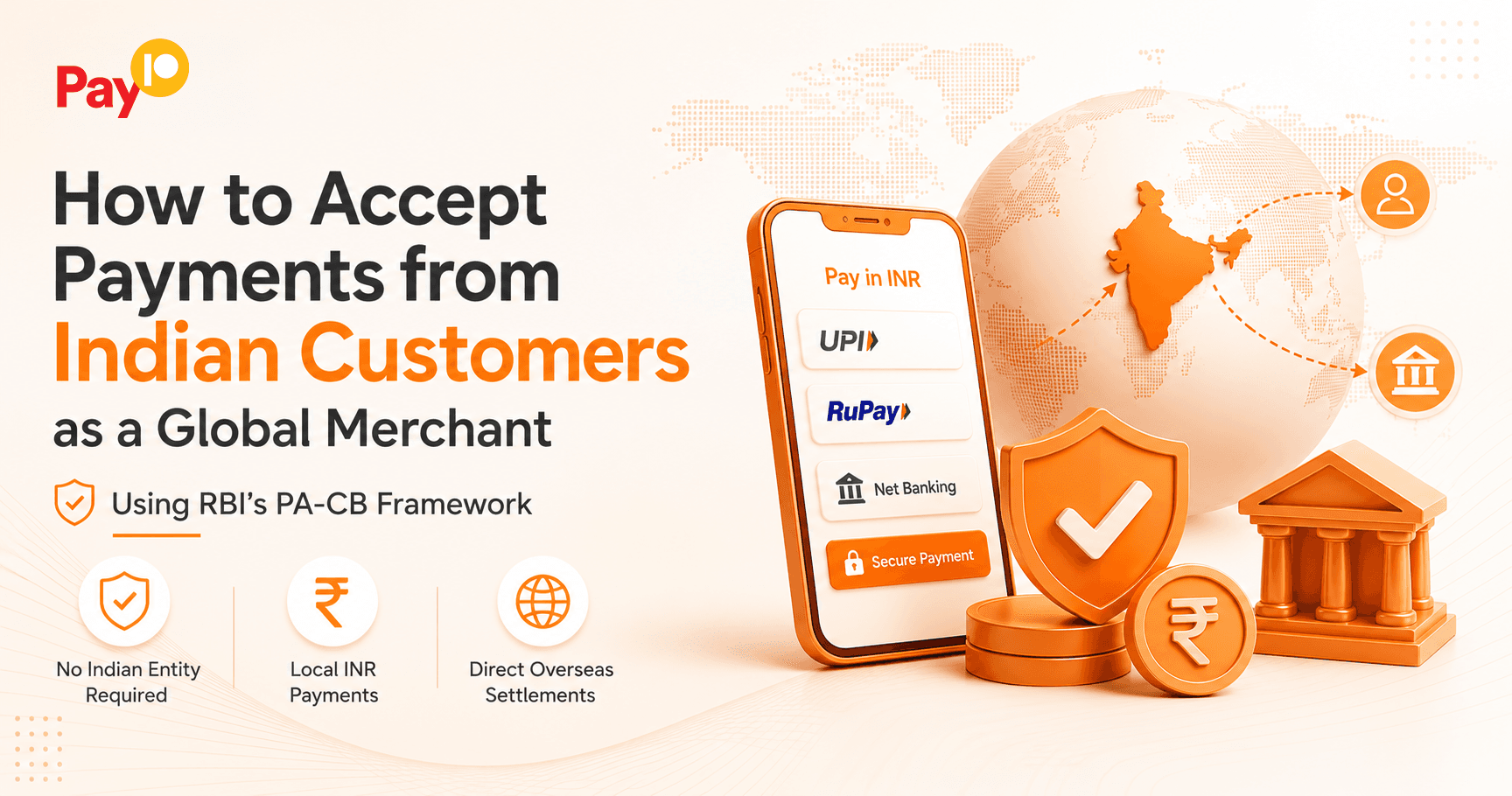
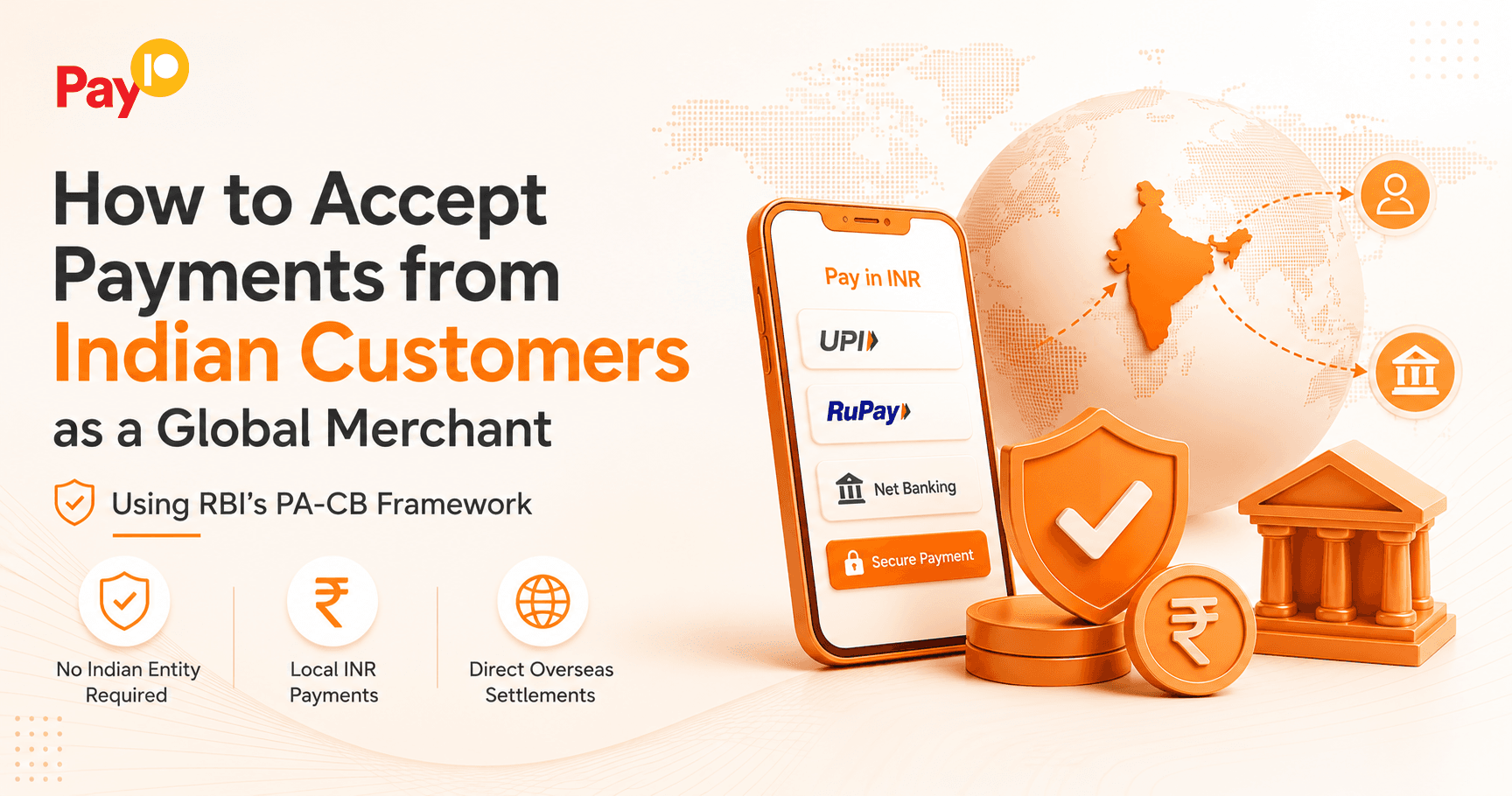
This creates two separate requirements. For domestic orders, Indian customers paying in INR via UPI, cards, or net banking, an RBI-authorized Online Payment Aggregator is needed. Pay10 holds this authorization, supporting UPI, RuPay, domestic cards, net banking, and digital wallets for Indian customers directly through the Shopify checkout. For international orders, overseas customers paying in USD, EUR, GBP, or other foreign currencies, a PA-CB-authorized payment gateway is required. Pay10 holds RBI PA-CB (Export & Import) authorization, which means it can handle both domestic and international payment acceptance for an Indian Shopify merchant within a single platform, covering the full payment stack without requiring separate provider setups.
This matters for KYC compliance beyond just payment acceptance. Under RBI's PA-CB framework, the payment provider facilitating cross-border collections must be directly authorized to do so. An Indian Shopify merchant routing international orders through a non-PA-CB-licensed gateway is creating a compliance gap in their settlement trail, one that surfaces at tax time, during a GST audit, or when FEMA documentation is requested.
Pay10's onboarding includes full merchant KYC aligned to FEMA requirements, with correct RBI purpose code tagging and automatic FIRA generation for every international inward remittance, so Shopify merchants get compliant payment documentation as part of the standard settlement flow, not as an afterthought.
For Shopify merchants exporting digital goods or services, software, subscriptions, or digital downloads, export of services is zero-rated under GST when sold to international customers. Filing a Letter of Undertaking (LUT) with the GST authority allows these sellers to export without paying IGST upfront and then claiming a refund. For physical goods exporters on Shopify, proper shipping bill documentation is required to claim the export GST exemption and any applicable IGST refund on inputs.
Key points for Shopify sellers in India:
Whether it is Amazon, Etsy, or Shopify, three things consistently determine how smoothly cross-border seller KYC compliance works in practice.
Document consistency across every platform. The legal business name, PAN, GSTIN, and bank account holder name must be identical across the marketplace account, the payment provider, and the bank. A single character difference, a missing middle name or a differently abbreviated business name is the most common cause of onboarding stalls and payout holds across all three platforms. Before submitting KYC documents to any marketplace or payment provider, verify that every document reflects exactly the same entity name and details.
Correct purpose code and category declaration. Every international payment received in India must be tagged with the correct RBI purpose code, the classification that tells banks and regulators what the foreign currency receipt is for. Software and IT services use P0802; consulting services use P1006; creative and design services use P0806. An incorrect purpose code can delay settlement, trigger a bank query, and complicate GST zero-rating claims. On the marketplace side, product categories must accurately reflect what is being sold; incorrect category declarations slow both marketplace approval and RBI-side compliance checks.
Working with a properly authorized payment partner. This is where the PA-CB framework matters directly for sellers. A payment gateway without RBI PA-CB authorization cannot legally aggregate cross-border payments for Indian merchants. Using one creates a compliance gap in the settlement trail that affects FIRA documentation, FEMA compliance, and the merchant's tax and audit position. Pay10's PA-CB (Export & Import) authorization, combined with its Online PA license, means Indian D2C sellers and Shopify merchants get a single, fully compliant payment infrastructure covering both domestic and international payment flows, without needing separate providers for each.
Built for the future of payments, Pay10 enables businesses to offer fast, secure, and scalable digital payment experiences.
The consequences of getting cross-border seller KYC compliance wrong are predictable, avoidable, and expensive enough to matter.
First payout delays. The most common issue for new sellers on any platform is consistently caused by incomplete KYC documentation, name mismatches between the seller account and the bank account, or missing IEC or AD codes for Amazon sellers. These holds rarely resolve quickly; bank verification cycles and marketplace support queues add days or weeks.
Missing FIRA documentation. Without FIRA - the official proof of foreign inward remittance, sellers cannot cremittance, sellersves, reconcile GST correctly, or prove the legitimacy of foreign income during an income tax assessment. FEMA requires these records to be maintained for a minimum of five years. Pay10 generates FIRA automatically for every eligible inward remittance processed through its PA-CB-authorized platform, removing the need to chase this document from the bank after each transaction.
Avoidable FX losses. Sellers who do not check their payment provider's actual exchange rate against the mid-market rate on the day of receipt consistently lose 1–2% of every international payout to hidden FX markup, embedded in the conversion rate rather than disclosed as a fee.
FEMA non-compliance exposure. FEMA requires export proceeds to be repatriated within nine months of the date of export. Sellers using non-PA-CB-authorized gateways or routing proceeds through informal channels, face real regulatory exposure under FEMA, particularly as RBI enforcement of the PA-CB framework tightens.
For Indian sellers running international sales through their own D2C website, a Shopify store, or payment links, alongside or independent of marketplace channels like Amazon or Etsy — Pay10 provides an RBI-authorized, PA-CB-compliant international payment layer that resolves the compliance challenges described in this guide at the infrastructure level.
Pay10 holds RBI authorization as both a PA-CB (Export & Import) and an Online Payment Aggregator - one of the few platforms in India with both licenses simultaneously. For cross-border sellers, this means every international payment received through Pay10 comes with correct RBI purpose code tagging, automatic FIRA generation, FEMA-aligned merchant onboarding, and T+2/T+3 settlement to the seller's verified Indian bank account. For Indian Shopify merchants specifically, Pay10 covers both the domestic payment requirement (UPI, RuPay, cards, net banking for Indian customers) and the international payment requirement (PA-CB-authorized cross-border collections in 100+ currencies) within a single integration, eliminating the need for separate domestic and international gateway setups.
Instead of managing a marketplace's payout rules, a separate Payoneer account, a domestic gateway for INR sales, and a bank request for FIRA after every foreign receipt, sellers on Pay10 get one system where documentation is consistent, settlements are predictable, and the compliance infrastructure is built to RBI's PA-CB standards from the start. PCI-DSS Level 1 and ISO 27001:2022 certifications apply across the platform.
Why Businesses Trust Pay10 | RBI Authorized Payment Aggregator | PCI-DSS Compliant | ISO 27001 Certified | 100+ Payment Options | Advanced Fraud Prevention & Risk Monitoring | Trusted by Enterprises & Growing Businesses | Scalable Infrastructure for India & Cross-border | Enterprise-grade Payment Technology | Secure UPI & Digital Payment Solutions