Pay10 is an RBI-authorized payment aggregator and fintech platform helping businesses across India simplify digital payments with secure, scalable, and enterprise-grade payment solutions. Trusted by startups, SMEs, enterprises, D2C brands, and growing businesses, Pay10 supports UPI, cards, net banking, wallets, payment links, international payments, and advanced merchant solutions designed for modern digital commerce.
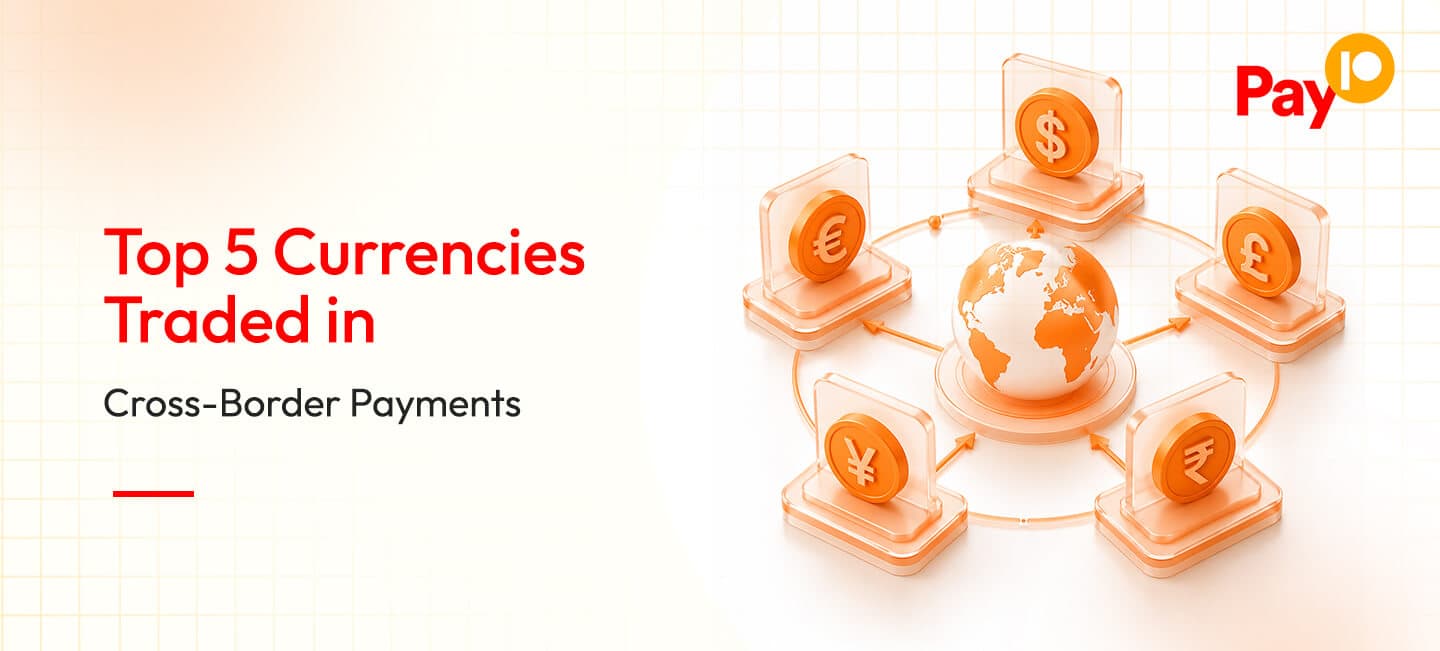
Cross-border payments are becoming a daily reality for Indian businesses. Exporters, SaaS companies, freelancers, and D2C brands are now selling to customers across the US, UK, Europe, the Gulf, and Asia. As international payment volumes grow, one factor consistently shapes every transaction: currency choice. Not all currencies are used equally in global trade. A handful dominate cross-border payments because they are widely accepted, easy to settle, supported by most international payment gateways, and backed by the deep liquidity that keeps conversion costs low.
But currency choice is not just a pricing decision. The currency you invoice in determines your exposure to exchange rate movement between the day you raise an invoice and the day the payment settles in INR. It affects the forex markup your payment provider charges, the settlement timeline, and in some cases the compliance documentation your bank requires.
For Indian exporters receiving international payments regularly, understanding which currencies dominate global trade and how to manage the risk that comes with them has a direct impact on margins and business growth. Pay10's PA-CB-authorized cross-border payment infrastructure supports collections in 100+ currencies with real-time conversion and no hidden FX charges, giving Indian exporters a single platform to manage all of this without juggling multiple providers.
The US Dollar is the most widely used currency in international payments and the undisputed default for global trade. A large share of global commerce, online marketplaces, SaaS subscriptions, professional services, and export contracts is settled in USD. For Indian exporters, USD is almost always the first foreign currency they encounter, whether they are receiving payments from US clients, settling Amazon Global Selling payouts, or billing international SaaS customers.
USD offers the deepest liquidity of any currency in global forex markets, which translates directly into the tightest conversion spreads when settling to INR. It is accepted across virtually every international payment gateway and cross-border platform operating in India, and it is the default settlement currency for most global marketplace payouts, including Amazon, Upwork, and Fiverr. For Indian exporters, invoicing in USD typically means the fastest settlement, the lowest conversion cost, and the widest acceptance by international clients, regardless of which country they are in.
The Euro is the second most traded currency in global cross-border payments and the primary settlement currency for trade with the European Union's 27 member states. For Indian exporters selling to Germany, France, the Netherlands, Italy, Spain, or other EU markets, EUR is the expected invoice currency for most B2B contracts and enterprise clients. Most international payment gateways in India support EUR collections with smooth INR settlement.
EUR is particularly relevant for Indian businesses in manufacturing exports, IT services with European enterprise clients, and B2B e-commerce. The EUR/INR exchange rate carries moderate volatility, less than GBP or JPY, which makes it a reasonably stable invoicing currency for Indian exporters with recurring European revenue. For businesses processing significant EUR volumes, the difference between a payment provider offering transparent mid-market EUR/INR conversion versus one embedding a hidden spread can represent a meaningful annual cost.
GBP is the third most relevant currency for Indian cross-border payments, driven by the historically strong trade and services relationship between India and the UK. It is commonly used by Etsy sellers serving British buyers, digital agencies working with UK clients, IT services exporters, and goods exporters with established UK distribution. GBP carries higher purchasing power per unit than USD or EUR, a £1,000 invoice settles to more INR than a $1,000 invoice at comparable rates, which matters for margin calculations when setting international pricing.
GBP/INR volatility is moderate to high relative to USD, reflecting the pound's sensitivity to UK economic and political developments. For Indian exporters with recurring GBP revenue, this makes currency risk management more important than with USD or AED. Locking in a favorable GBP/INR rate via a forward contract, or using a multi-currency account to hold GBP and convert at a preferred rate, can meaningfully protect margins.
The Japanese Yen remains significant for Asia-oriented cross-border payments, particularly in manufacturing, technology components, and industrial trade between India and Japan. Japan is one of India's major trading partners in capital goods, electronics, and automotive components, sectors where JPY-denominated contracts are standard. JPY is also used in cross-border payments for Japanese e-commerce platforms and regional trade finance.
JPY carries moderate forex risk relative to INR and is known for significant appreciation during global risk-off periods, which can work in an Indian exporter's favor or against them depending on timing. For exporters with occasional JPY transactions, the conversion cost is typically manageable. For those with regular JPY revenue, monitoring the JPY/INR rate and using a payment provider that offers real-time conversion without hidden FX markup, as Pay10 does, makes a meaningful difference to settlement outcomes.
Power everyday transactions with secure digital payment infrastructure built to support scale, speed, and convenience.
The Chinese Yuan is growing in importance in global trade, reflecting China's position as the world's largest goods exporter and India's significant bilateral trade volumes across manufacturing and supply chains. CNY is increasingly used for Asia-led trade flows, particularly in manufacturing inputs, raw materials, and supply-chain payments between Indian and Chinese counterparties.
CNY carries a specific characteristic that distinguishes it from the other currencies on this list: it is more regulated than freely floating currencies like USD, EUR, or GBP. China maintains managed convertibility for CNY, which means cross-border CNY transactions involve additional regulatory steps compared to other major currencies. Liquidity for CNY settlement is lower than USD or EUR, and conversion spreads can be wider. For Indian exporters whose trade involves CNY flows, working with a payment provider that has robust multi-currency infrastructure is particularly important.
AED has become one of the most practically important currencies for Indian exporters in recent years, reflecting the rapid growth of India-UAE trade across goods, services, and digital commerce. The UAE is India's third-largest trading partner and one of the fastest-growing destinations for Indian D2C brands, SaaS companies, and service exporters. AED carries one characteristic that makes it particularly attractive as an invoicing currency: it is pegged to the US Dollar at a fixed rate of 3.6725 AED per USD, giving it the price stability of a USD-linked instrument without the full USD exposure.
For Indian exporters billing Gulf clients, invoicing in AED eliminates the currency risk inherent in freely floating currencies, the AED/INR rate moves only as USD/INR moves, which is generally less volatile than GBP/INR or JPY/INR. The UAE's growing regulatory framework for digital payments and e-commerce also supports faster cross-border settlement for India-UAE corridors.
Pay10's cross-border payment infrastructure covers AED as part of its 100+ currency suite, making it straightforward for Indian exporters to invoice Gulf clients and settle directly to an Indian bank account.
SGD is the key settlement currency for Indian businesses selling into Southeast Asia, with Singapore functioning as both a direct market and a regional financial hub for the broader ASEAN region. SaaS companies, B2B service exporters, fintech firms, and professional services businesses with Southeast Asian clients most commonly encounter SGD in their cross-border payment flows. Singapore's status as a major financial center means SGD transactions benefit from strong regulatory infrastructure, high banking liquidity, and relatively efficient cross-border settlement.
SGD/INR volatility is low to moderate, comparable to USD in behavior, and supported by Singapore's well-managed monetary policy. For Indian SaaS and technology exporters using Singapore as a Southeast Asian market entry point, SGD is often the preferred invoicing currency because it is accepted across the region and converts to INR efficiently through major payment providers.
Built for the future of payments, Pay10 enables businesses to offer fast, secure, and scalable digital payment experiences.
| Currency | Best Suited For | Volatility vs INR | AED/USD Peg |
|---|---|---|---|
| USD | Global trade, SaaS, marketplaces | Low to moderate | No |
| EUR | B2B exports, EU marketplaces | Moderate | No |
| GBP | UK services, Etsy, agencies | Moderate to high | No |
| JPY | Manufacturing, tech exports | Moderate | No |
| CNY | Asia trade, manufacturing | Regulated, lower liquidity | No |
| AED | Gulf D2C and e-commerce | Low (USD-pegged at 3.6725) | Yes |
| SGD | Southeast Asia B2B/SaaS | Low to moderate | No |
All seven currencies are supported within Pay10's 100+ currency international payment gateway, with real-time currency conversion through AD bank partnerships and no hidden FX markup on settlement.
When Indian businesses send or receive international payments, the currency used affects far more than the number on the invoice. It directly influences
Holding or waiting to convert foreign currency exposes a business to exchange-rate movement between the day an invoice is raised and the day it settles in INR. For occasional, small transactions, this rarely matters.
For exporters with recurring, high-value international revenue in GBP, JPY, or EUR, a one or two percent swing in the exchange rate between invoice date and settlement date can meaningfully affect margins, and with no action taken, that risk is borne entirely by the exporter.
The most traded currencies in cross-border payments remain USD, EUR, and GBP for Western markets, with JPY and CNY relevant for Asian trade corridors. AED and SGD are growing quickly as Indian exporters expand into the Gulf and Southeast Asia, two of the fastest-growing destinations for Indian digital and physical exports.
For Indian businesses, understanding which currencies your customers actually pay in, and having a payment infrastructure that supports all of them transparently, compliantly, and without hidden FX costs, is not a back-office detail. It is a direct driver of margin and cash flow.
The right international payment gateway handles currency conversion, FEMA compliance, and FIRA documentation automatically, so you can focus on growing your international revenue rather than managing the settlement complexity behind it.
Explore Pay10's international payment gateway or get in touch with the Pay10 team to start accepting payments in 100+ currencies.
Why Businesses Trust Pay10 | RBI Authorized Payment Aggregator | PCI-DSS Compliant | ISO 27001 Certified | 100+ Payment Options | Advanced Fraud Prevention & Risk Monitoring | Trusted by Enterprises & Growing Businesses | Scalable Infrastructure for India & Cross-border | Enterprise-grade Payment Technology | Secure UPI & Digital Payment Solutions